Showing posts with label books. Show all posts

26 April 2026

Analysis of the book “Unity 6 Editor Tools Essentials – Vol. 1” by Harrison Ferrone

Book cover

The publisher Jettelly is very young, but it is releasing some very interesting titles. They started with books about shading in Unity and Godot, and little by little they have been expanding the range of topics. The wait until they finally released this book felt long. Although they offer the option to buy it in advance at a discount while the chapters are being completed, I don’t have enough patience to read books in fragments. That’s why, even if I lose the discount, I prefer to wait until they are finished. In this case, I was really looking forward to it because in my projects I have found myself countless times needing to develop custom inspectors to make editing my components easier. Over time, I’ve learned how to do this, but Unity’s documentation is not the clearest in the world on the subject, and the technological shift to UI Toolkit has not helped to clarify things. Even so, I still had many doubts about whether I was doing things the right way and, in any case, about the reasons why they had to be done that way.

Fortunately, this book has cleared up many of those doubts. It follows an incremental structure, starting with the simplest editor customizations—Property Drawers and Decorator Drawers—and then gradually increasing in complexity while building on the previous concepts. The process is so gradual and clear that it’s easy to understand the new concepts being introduced. It’s true that I already had some prior knowledge from my earlier tinkering with UI Toolkit, but that actually helped me see that the author hasn’t taken shortcuts; instead, he explains everything from the beginning without skipping anything.

In the end, the book covers the following topics:

  • Property Drawers and Decorator Drawers
  • Attribute Drawers
  • Custom inspectors
  • Custom editors
  • Interface design with UI Builder
  • Creating interfaces to edit ScriptableObjects

The examples presented are very simple, with very limited functionality, but they are more than sufficient to focus on learning how to use Unity’s UI Toolkit without getting distracted by other matters. The code used is also clear and well structured.

It’s also worth appreciating that the book’s layout is pleasant to look at and makes the text easy to read. I don’t know what the printed version is like, because I read it digitally, but at least in this version the illustrations are in color, which is very helpful for distinguishing the details of the interfaces being explained.

In the end, this book has been so enlightening that I want to use it to revisit the custom editors I had already created. I’m sure I’ll be able to simplify them with what I’ve learned here. On the other hand, it has helped me overcome my fear of creating custom interfaces—a task I used to undertake only when necessity left me no alternative, but one that I will undoubtedly approach with much greater peace of mind in the future.

The publisher promises that a second volume of the book will be released. I hope that’s the case, and soon.

15 December 2025

Review of the book "Game Design Workshop" by Tracy Fullerton

Book cover
There are many ways to get into video game development. We all start from our love of playing, but some of us have a technical background and dive straight into programming with an engine, others get involved after dabbling in modding or level creation for a specific game, and some even come from the world of physical board games.

This book is for all of them because it begins with the most abstract concept of what we call a game and, although it eventually focuses on video games, it emphasizes the creative process of generating ideas, finding the most promising ones, testing them with a prototype that doesn’t have to resemble its final form, and starting an iterative refinement process until you arrive at something genuinely fun for its concept itself (and not for its implementation). Only then does development begin. In fact, the book doesn’t start addressing what we know as development until its last third, and even then it doesn’t deal with the technical side of development—there isn’t a single line of code in this book—but rather the planning and management of a group’s work.

The book adopts the perspective of the video game designer. While this is a very specific role within a development team, it is the one with the most transversal responsibilities, as the book explains, and therefore has the greatest visibility of the entire process—hence its importance.

The first two-thirds of the book explain the role of the video game designer; what we understand by a game; what its fundamental elements are; what elements enrich it to give it the desired character; what the most common gameplay dynamics are according to that character; how we can maintain player interest over time; and how we can keep the game balanced to avoid player frustration or, worse, boredom. It then moves on to how to filter and refine game ideas, giving enormous importance (and entire chapters) to the process of prototyping and testing those prototypes with real players (outside of the designer). Proof of the book’s decidedly “meta” approach is its insistence that tested prototypes start out as physical ones, even on paper and cardboard, long before creating the first digital prototype. This approach of avoiding digital prototypes until very late in the process may seem surprising to those of us who enjoy writing lines of code, but the author convincingly and refreshingly explains the reasoning behind it.

The last third deals with development itself, but with a “hands-off-the-keyboard” approach. Here, the book puts you in the shoes of a team manager who must coordinate multiple specialists to shape a game that can be sold. The entire book has a very realistic tone, but this is where it stands out the most. The author makes a notable effort to convey the day-to-day life of a video game development studio, both in its internal tasks of creating the game and in its interactions with key external actors for testing, funding, and distribution, such as testers and publishers. To do this, it explains how to structure development teams, what roles are common, and how they can interact efficiently and healthily. It then explains how agile methodologies can help humanize development and improve the product. I particularly liked how it explains the workings of the video game market and prepares you for how to approach a publisher so they choose to finance your game. It even goes as far as to discuss typical contracts between publishers and development teams, so you understand how milestone-based payment systems work during development, and later, royalties after the game’s release. It’s a fascinating reality check that demystifies the world of video game development while also showing the enormous effort behind a game that successfully sells.

All of the above is already immensely valuable, but the book is also enriched with testimonials from many game designers. You’ll find that more than one has created games you’ve enjoyed. In these testimonials, each designer shares how they entered the world of game design and development, what attracts them to it, and what creative process they follow when shaping a game. Reading them humanizes the role of the designer, puts faces to the people behind the games you’ve loved, and lets you learn about the life paths they followed to reach the point of creating the games that made them famous. Many of those paths were not easy. More than one even advises against entering the industry unless you have a clear vocation or passion, as it’s neither an easy profession nor one that will make you rich. But all of them confirm that if you truly want to make games and are willing to put in the effort and sacrifices, it’s a profession that can be deeply fulfilling.

Therefore, if you not only love games but also how they’re made, this is your book. It’s a refreshing reality check that demystifies, humanizes, and highlights the creative effort behind what you enjoy on your PC or console. A truly recommended book.

23 June 2025

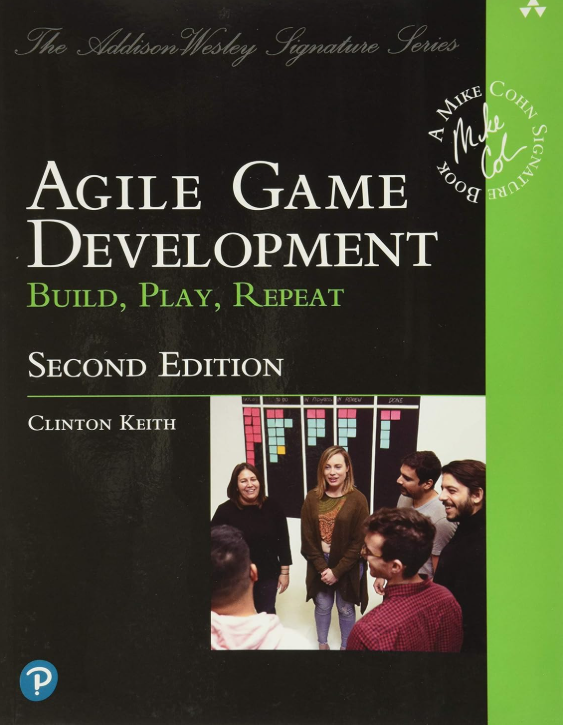
"Agile Game Development: Build, Play, Repeat" by Clinton Keith

Agile development techniques are revolutionizing the way software is created, enhancing collaborative work and enabling development teams to better adapt to constant market changes and initiate virtuous cycles of continuous improvement.

Instead of planning the entire project from the beginning (as in traditional waterfall development methods), agile techniques divide the work into small parts called "iterations" or "sprints" (usually lasting 1 to 4 weeks). At the end of each sprint, a functional part of the product is delivered. This iterative nature of the work aims to establish constant communication channels between the development team and its clients, empower the team to respond quickly to changing client needs, and deliver software frequently so that clients can start gaining value early and raise alerts as soon as the software does not meet their expectations. All of this is achieved by promoting the self-organization of the development team and improving their motivation.

Based on these general principles of agile development, there are methodologies that translate them into concrete, everyday work mechanisms. One example is Scrum, which proposes the aforementioned short cycles and a range of roles and regular meetings so that everyone involved in the project (not just developers) can understand its status and influence its evolution. It is also common to combine this with Kanban techniques, using boards with columns to help visualize the workflow and avoid bottlenecks; or to include Extreme Programming (XP) techniques to improve code quality, using practices such as pair programming and automated testing.

The world of video game development is no stranger to these techniques. In fact, the highly creative nature of video games and the ever-changing tastes of consumers make it highly advisable to avoid rigid waterfall development and instead adopt the aforementioned agile techniques.

The book "Agile Game Development: Build, Play, Repeat" by Clinton Keith struck me as the ideal work for both beginners and those looking to deepen their understanding of this topic.

It is a very mature work, written by a Scrum professional who previously worked in traditional development (for U.S. fighter jet control systems) and later in top-tier video game studios. This prior experience constantly surfaces through real, enriching, and entertaining examples that help contextualize the theory, unlike many similar works. Other books merely explain what Scrum is, but this one starts with the problems that waterfall development posed for the video game industry, using examples and anecdotes that are truly entertaining, enlightening, and deeply human (it's comforting to know that "everyone has their struggles").

From these challenges, the author explains in great detail the principles of agile development and how the Scrum methodology brings them into daily practice. In the first chapters (approximately the first third of the book), the description of Scrum tasks is similar to those performed in more generic application development. In fact, since I had already read other books on Scrum, my first impression during those chapters was "Scrum seems to apply exactly the same in video games as in general applications." This is not a criticism—on the contrary, I believe this first third is valuable for those new to Scrum, as the examples are from the video game world, very visual, easy to understand, and fun, yet perfectly applicable to general development.

The remaining two-thirds are where, fortunately, the book diverges from more generic Scrum works and delves into the peculiarities required by video game development. It details cases where the literal application of Scrum would not work in a video game development team and the approaches the author has seen to solve these issues. The result is not only a practical reference manual on how to lead a video game development team but also a testimony to the highs and lows of this market segment.

Therefore, I believe this work is essential for anyone looking to mature, making the leap from solo hobbyist development to team-based commercial development. Developing is not just about programming, but about delivering something functional to our clients that they can enjoy. This book will teach you how to achieve that.

30 January 2025

"Game Development Patterns with Godot 4" by Henrique Campos

Apps and video games have been around for so long that it's hard to find yourself in the middle of a problem that hasn't been solved by another developer before. Over time, this has given rise to a set of general solutions that are considered best practices for solving common problems. These are known as design patterns; a set of "recipes" or "templates" that developers can follow to structure their code when implementing solutions to certain problems.

It is a subject that is studied in any degree related to programming, with the book " Design Patterns, Elements of Reusable Object-Oriented Software " by Gamma, Helm, Johnson and Vlissides (the famous Group of Four) being the classic book that started this branch of study. 

However, when told in an academic way, design patterns can be difficult to understand and their application is not always clear. This is precisely where Henrique Campos' " Game Development Patterns with Godot 4 " shines.

Campos quite successfully selects 9 of the 23 design patterns enunciated by the Group of Four and explains them in a clear, simple way, rich in examples applied to game development. The patterns chosen by Campos seem to me to be the most useful and the ones with the most immediate application in any game. I have not missed any of the other remaining design patterns because they always seemed too abstract and esoteric to me.

In a very original way, Campos presents his examples based on dialogues or communications between the designer of a fictional game and his programmer. In these communications, the designer demands functionalities focused on enriching specific aspects of a game, while the programmer receives these demands and has to fit them with his objective of creating a scalable and easy-to-maintain code. In each of these examples, a specific design pattern is explained as the best solution to fit the designer's demand with the programmer's objective.

Following this scheme, the author explains the singleton pattern, the observer pattern, the factory, state machines, the command pattern, the strategy pattern, decorators, service locators and event queues. All of this in an order of increasing complexity and based on the previous ones. Along the way, he also explains in a simple but effective way basic principles of development such as those of object-oriented programming or the SOLID principles.

The examples are implemented in GDScript, using Godot 4. I must admit that I was initially a bit wary of the book because I didn't think GDScript was a rich enough language to illustrate these patterns (I admit that I develop in Godot C#). However, the field code is very expressive and GDScript is so concise that the examples end up being read as if they were pseudocode. In the end I didn't miss C#, because the GDScript code managed to convey the idea of ​​the examples in just a few lines, which made them very easy to read and understand.

Therefore, I think it is a highly recommended book that makes a subject that is often repulsive due to the excessively academic treatment it has received in other previous works, enjoyable and fun. If you give it a chance, I think you will enjoy it and it will help you considerably to improve the quality of your code. 

01 September 2024

"Creating an RTS Game in Unity 2023" by Bruno Cicanci

Book cover
In any learning process, there comes a point where you surpass the initial level and from there, you enter the intermediate stage. There are still many things you don't know, but you find that the available bibliography drastically reduces. There are many books to introduce you to the world of game development, but not as many for the intermediate-advanced level.

I started this book because the table of contents promised to cover topics not commonly found in other books on Unity, such as level creation, tool development through editor extension, multiple unit selection, formations, resource management, fog of war, or customizing builds. However, I had my reservations, given my past experiences with PacktPub books.

Fortunately, this book has proven to be above average compared to others from the same publisher. It indeed covers those topics and more, in a thorough and clear manner, using expressive and high-quality source code. I could tell that the author is a good developer and knows what they're doing. Thanks to this, I’ve learned a few new things along the way—things I didn't know and that will now enrich my way of developing in Unity. At this stage, that's no small feat.

To illustrate everything, the book develops a real-time strategy game, akin to War of Warcraft, with a top-down perspective. As you might imagine, it’s all done with free resources and in a mock-up mode, but I have to admit it touches on many aspects that should be considered in a game of that genre.

If I had to point out one downside, there was one feature I was particularly interested in, the fog of war, and I was disappointed that one of the elements used to implement it was a legacy feature. It’s impossible to guarantee that a technical book will remain up-to-date after a few years, but recognizing yourself, in your book, that you're going to use a legacy feature... I find that quite disappointing. Everything explained in a technical book should be current at the time of its writing.

Aside from that small detail, the truth is that it’s a recommendable book from which you can learn a lot. Highly recommended.

08 May 2024

"Programming Game AI by Example" by Mat Buckland

It's not easy to find good books on artificial intelligence (AI) applied to games. Most of them don't go beyond the introductory level, and when they explain the A* algorithm, they consider it advanced material and leave it there. In my opinion, the real gem in this field is Ian Millington's "AI for Games," which combines vast content with clear, detailed explanations that are truly relevant to game development. Since I read it, I hadn't come across another work that could compare until I stumbled upon the one we're discussing in this article. It's worth noting that Buckland's work was one of Millington's references.

While "Programming AI by Example" may not match the breadth of content in "AI for Games," it certainly delves into the topics it covers with great depth and clarity. It's also worth noting that it addresses several topics absent from Millington's work, such as integrating scripting systems into our games (to simplify AI algorithm design) and the chapter on goal-driven agents.

The book is filled with good illustrative figures that aid comprehension.

Unlike Millington, the implementations are illustrated not in pseudocode but in C++, which, in my opinion, is a downside because it's not exactly the most intuitive language in the world. However, the explanations are extensive and clear enough that a full understanding of the code is not essential.

I also noticed the emphasis on showing UML diagrams of the class hierarchies of the different implementations. I understand why this is done, and it's not excessive, but it made me smile because it feels somewhat outdated. UML diagrams are not commonly seen in books anymore.

Despite all these signs of the time elapsed since the book was published, the field of AI for games has not advanced so much as to render its content obsolete. The principles it covers remain relevant. If anything, some tools that have emerged later, such as behavior trees or neural learning, are missing.

In conclusion, I found the book excellent. I recommend reading it before Millington's. That way, you can enhance its usefulness as an introductory piece to facilitate later understanding of Millington's work and expand on what Buckland leaves pending. With this approach, I believe you'll cover the best of what has been written so far in the field of AI for games.

07 January 2024

"Artificial Intelligence in Games" by Paul Roberts

The best book I've read so far on how to develop game AI is AI for Games by Ian Millington. The problem is that there aren't many books on the market that cover the game AI branch in a practical way. The ones that exist are either too theoretical or they only cover a couple of topics, such as pathfinding and state machines. That's why I read Game AI Programming with Unity by Paul Roberts with eagerness.

Fortunately, it has a practical and introductory approach. I would recommend that anyone who wants to get started in the world of game AI read this book before Millington's, since Roberts's book doesn't go as deep, but it's written in a more plain language. It's ideal for a first contact with the different branches of AI used in games, to then go deeper with Millington.

The topics it covers are varied and interesting: steering behaviors, terrain analysis with influence maps, pathfinding, decision structures, fuzzy logic, minimax, genetic algorithms, and neural networks. Unlike Millington's, you won't end up with enough knowledge to implement your own version with Roberts's book, but you will have a good understanding of the main concepts, which will make things much easier when you start reading more detailed texts.

The Kindle digital version has some defects that have made it difficult to progress at times, mainly that the formulas are not well formatted and have lost most of the operators in the digital conversion. So it's very difficult to get an idea of the formula just from what's in it. Fortunately, the formulas are not abundant or complex, so in the end you end up figuring out what they mean, even though you have to think about it for a while. I really don't understand why he didn't do the same with the diagrams, which are hand-drawn and digitized, but at least they are understandable. If he had done the same with the formulas, there would have been no problem.

But more than the theory, whose depth I have already said is quite scarce, where the book really shines is with the practical part. The author has developed a series of mini-games in Unity to test the concepts of the book. So, after the theoretical part of each chapter, there is another part in which he guides you, step by step, in a tutorial format, to implement those concepts to create an AI that will face you in the mini-game. It must be recognized that the author has made an effort to create complex, well-presented mini-games that are very well suited as a platform for testing theoretical concepts. I think this is the main value of the book. There are others that explain the different concepts better and more in depth, but they stay in theory. Having the opportunity to tinker with and test these concepts directly in a game is something that only this book has offered me so far.

So, it's a book that I recommend. Recognizing its limitations and defects, I think it's a book that adds value to the limited ecosystem of books on game AI.

24 December 2023

"Godot 4 Game Development Cookbook" by Jeff Johnson

This book was part of the latest bundle from Humble Bundle, which included books for developing games with Unity and Godot.

The book offers a series of tutorials on specific use cases of Godot. It is fair to say that the index is suggestive and covers intermediate-level topics, ideal if you already have some experience with other engines and have just finished the initial Godot tutorials.

There is an introduction to the advanced features recently introduced in GDScript 2.0. It explains how to introduce volumetric fog in scenes, decal particle systems, pathfinding, deformable models, tiles, sound emitters, and offers an initial approach to Godot's multiplayer features.

It also offers recipes on shaders, but they are so superficial and the topic is so extensive that I found those recipes to be practically useless.

The different recipes follow a common structure. First, a very brief description of what is to be achieved with the recipe is offered. Then there is a "How to do it" section where the steps to be taken through the Godot editor are listed. Finally, there is a "How it works..." section that is supposed to explain in depth the steps that have been taken in the previous section.

I think the selection of topics for the recipes is very appropriate and suggestive. The description of the tasks to be performed is clear and I have had no problems following them. Although in some cases, I had to add some things for it to work and I had to complete it on my own. In general, I have enjoyed the following practices because they have allowed me to discover how far Godot can go.

However, where the book falls short is in the "How it works..." sections. It's okay if the "How to do it" section is limited to listing steps, but the "How it works" section is supposed to be where it should explain in detail why the previous steps have been taken and thus delve into the engine's features. Instead, what the author does is simply recount the tasks performed, but in a literary way instead of a numbered list. In other words, the "How it works" section does not add anything to the "How to do it" section. If you have more or less understood the steps in the "How to do it" section, you can skip the "How it works" section because it will not add anything to you. This greatly limits the value of the book. My advice, if you read this book, is to consult the Godot documentation for the different components as you progress through the steps of the different tutorials. This way, you can partially make up for the lack of explanations from the author.

In my opinion, this is a new example of Packt's poor editorial work. I think the problem with the book is not that the author is unfamiliar with the subject, but that the editorial did not review the book and did not alert him that he was focusing the "How it works" sections incorrectly. Packt is still a machine for churning out books where quantity is valued above quality.

I do not regret having read this book. It has really allowed me to tinker with Godot and convince myself that it is a viable engine for making games of all kinds. It is not that there are many books about Godot 4 on the market. In fact, most of them are from Packt, so there is little alternative. The thing is, I don't think the book is worth its full price. It may be worth it if it is discounted or included in a bundle like Humble Bundle, but I don't think it is worth the usual price. Before that, there are multiple tutorials on YouTube that are much better and more affordable.

11 November 2023

"Godot 4 Game Development Projects" by Chris Bradfield


I have said on occasion that I do not like Packt Publishing books. I have always felt that they prioritize quantity over quality. The fault is not usually with the authors, as there are both good and bad authors at Packt, but rather with the publisher for not doing its job of polishing the content to meet a minimum quality standard before it reaches the public. As a result, there are too many Packt books that have the whiff of a tutorial that has been copied and pasted straight from the internet, with inconsistencies, repetitions, and errors in content and formatting. In most cases, if the publisher had done its job and provided at least some guidance to the authors, the result could have been much more decent. There are things you can forgive an independently published book, but when there is a publisher behind it that charges the same price as an O'Reilly book, I think the level of expectation has to be higher. On the positive side of the ledger, and for what I believe still saves their business, is that the enormous amount of publications they put out cover very novel and varied topics that other publishers will take at least a year and a half longer to cover, and with much fewer books. It is not uncommon to search for a book on a hot topic and find that Packt is the only publisher with books on the subject. Another thing is their quality level, as I have already said. That is why I usually avoid Packt books, unless I find a pack of their books at a good price. In this case, the book that gives its name to this article was included in a pack of game development books that was released through Humble Bundle. For almost €20, I bought a couple of dozen Packt books, so for that price it was worth it. Based on the above, this book has the advantage that there are very few works that talk about game development with Godot, and even fewer about its recently released version 4, which incorporates enough new features to make it very different from previous versions. It is structured as a series of projects that act as tutorials. There are three 2D projects, of increasing difficulty, and two 3D projects. This structure makes the book practical and entertaining, but it does not delve into the design and approach particularities that make Godot so special compared to, for example, Unreal or Unity. Still, if the tutorials in the official Godot documentation have left you wanting, this book can be a good follow-up to them, as it is very similar to them in both form and content, but it takes them a couple of steps further. In fact, I really enjoyed the last chapter, which talks about how to create procedural levels in real time. The tutorials are detailed and clear to follow. The code it uses is GDScript, and I would say it is clean and well-structured code. I think that in general, the way of working with Godot that is seen in the book is not far from the official best practices. So it is a good introductory work to Godot. On the negative side, there is the typical carelessness of a Packt book. At least in the digital version, which is the one I read, the first lines of the code listings are cut off on the left. It is as if they had cut off everything that was to the left of the first or second level of indentation. This means that the body of many functions is saved, but you have to guess the name of the function and the global variables from the incomplete fragment that you get. I found this very annoying. I have no idea how the book could have passed the quality filter like this, assuming that Packt even does one. Did it pay off? Considering that I bought the book in a pack and therefore it came out at a ridiculously low price, that there are not many Godot books (and even fewer Godot 4) and that I had already finished the official Godot tutorials, then yes, it was worth it. Having all the tutorials collected in a book is very convenient, although you can find others just as good with a little internet research. If I had bought it for the price it is on Amazon, or at Packt itself, I don't know if it would have been worth it.

30 October 2023

"Robust Python: Write Clean and Maintainable Code" by Patrick Viafore


When you don't make a living from programming but are simply an amateur who likes to program, the difficult thing is not learning multiple languages ​​but keeping them alive without forgetting them. When you can only dedicate a little time a day, you focus on a project with a certain language and the rest of them become rusty. It is true that there are books with which to review, but over time you surpass the basic level and no longer just any book will do to keep a language fresh. I'm afraid I've reached that point with Python and I was a little desperate to find a book that would really give me something new. Until I was fortunate enough to acquire this book in a package (blessed Humble Bundle).

"Robust Python: Write Clean and Maintainable Code" by Patrick Viafore is not a book for novices, or even for intermediate developers, but rather for experienced developers who will most appreciate the proposals in this book for developing complex applications that can be maintainable over time.

The book begins by explaining Python's optional typing system and takes it much further than Internet tutorials to an unusual level of sophistication. Did you know that you can define interfaces in Python? Did you know that you can define your own types? Dataclasses, Enums and other types are presented here with very interesting functionalities that are not even glimpsed in the introductory texts.

After that, it dives deeper into some of the SOLID principles and architectures, such as events, to fulfill them. All this, following some simple and easy to understand examples.

Finally, the Python ecosystem for automated testing is discussed extensively, explaining multiple strategies.

I liked the book a lot. It's to the point, it's enjoyable and it really provides new tools that don't usually appear in other books at this level. In short: a very good purchase if what you want is to polish your Python to start becoming an expert.

20 October 2023

Game AI Pro 360 - Guide to Tactics and Strategy


There are many books about artificial intelligence (AI), but most are either very academic, take a purely educational approach, or focus on more applied topics such as machine learning and data analysis. The bibliography on AI focused on video games is very scarce, especially if you are looking for it in digital format (in my case Kindle).

However, one of the great authors in this field is Steve Ravin, not so much for his own contributions as for his work compiling those of others in his works. His is the series of books "AI Game Programming Wisdom" of which this is one of his latest exponents. As in the previous ones, each chapter of this book is an article by a different author, developing a concept related to AI in video games. Unlike the previous books, which had articles covering a wide range of areas, in this one all the articles focus on the facet of analysis and the making of tactical and strategic decisions.

The main value of the book is that the authors of the different chapters are professionals specialized in this field who work in reputable video game studios. Thus, the problems, nuances, and approaches they propose are backed by their extensive experience. The authors' competence is also evident in the academic air that emanates from each of their pages.

However, the main handicap of the book is precisely this: the work background of its authors. Coming from large studios, they must be subject to confidentiality clauses and I suppose that is the reason why they do not go into detail about specific implementations, since they could compromise the intellectual property of their companies. These authors can explain the general concepts adopted in their games, but they cannot reveal the details of how they have put them into practice without compromising the core of those games.

For this reason, the book moves at a very conceptual level in which they propose really interesting things, but it falls short when it comes to explaining how they have implemented them. Code snippets are conspicuous by their absence and when they appear they are mere pseudocode that in reality does not fully explain the concepts raised. There have been complete chapters in which I lost the thread after a few pages and I did not know how to fill in the gaps that the authors were leaving. In others I have understood everything they were proposing, but I was left wanting an example of a real implementation.

Probably I lack the level that the authors have, but my conclusion is that it is certainly not a book to get started in the field of AI for video games. For this, I recommend the book "AI for Games" by Ian Millington before this book. This last book, does go from an introductory level to a medium-high level and with all the details. I thought that this book would already leave me prepared for others, already at an intermediate level, but it turns out that not for this one by Steve Ravin.

Do I regret having read it? No. When I was able to get the hang of the chapters I enjoyed them and I came up with a couple of ideas that even though I don't know how to implement them yet, they have been suggestive enough for me to try them at the first opportunity.

Verdict of the book: not suitable for beginners, but an interesting read to get you familiar with the concepts that drive the AI of major video games.

24 February 2023

Introduction to Game Design, Prototyping, and Development: From Concept to Playable Game with Unity and C#


Introduction to Game Design, Prototyping, and Development: From Concept to Playable Game with Unity and C#
 by Jeremy Gibson Bond is a great book to start with game development. Whereas other books focus on Unity development, Bond shows his academic experience with an overall focus that includes both theoretical concepts and technical ones. It's well thought structure has an academic smell indeed, but this one is for good and will give a knowledge that won't fade in few years or few versions of your specific game engine.

The first part of the book is focused in theoretical topics beginning with a high abstraction level and descending afterwards to detail step by step. In fact, it begins describing the concept of what we know as a game and which are its elements and structure. Take note that I've said game and not specifically computer game. This book part concepts are so general that author encourages to practice them with pencil and papers. It's evident that Bond is a great board and role playing games fan, starting with D&D, by his several references to that kind of games and its mechanics. This part goal is that the reader can model the game in his head, focusing in the mechanic development needed to make it appealing to be played. In this part has been specially suggestive the layered structure for the different games kinds that are inside a game: there is the game intended by its creators when they designed its rules, there is the game that rises when the game is played at the table, and then there is a game than appears when people start to mod the game and evolves it beyond what its creators thought (modding fan will really enjoy this part).

The second part deals with game design. Starting from theoretical concepts different parts of a game are defined, first with paper prototypes played by different tester rings. Here is specially interesting the part where the subtle ways to guide player are covered. In this part event Agile and Scrum is covered. 

I think this two first part will be the most interesting for seasoned Unity developers.

The third part implement paper prototypes in technical prototypes, more similar to the end game. Here is where Unity basic topics start, from the very beginning starting from editor layout setup and later with C# Unity development. Those who already know about C# and Unity probably will read fast these pages, although I don't recommend to skip them because you ca still learn useful tips. I've developed a lot in Unity and I'v still learned one or two things.   

The fourth part is focused in prototype development to cover some of the basic game kinds. They are like mini tutorials being each of them a different game. Those who are starting with Unity development will find here and excellent way to advance learning even good practices. 

So, it is a complete book, well structured and didactic, with a lot of links and book references to continue after ending this book. I recommend it both to those who already know Unity and want to start with game design, and to those who are starting and want to learn Unity from the scratch.


07 May 2020

Linux Firewalls by Michael Rash


Linux Firewalls: Attack Detection and Response with iptables, psad, and fwsnort is a quite interesting book about iptables features to be configured as an UTM device through its integration with Snort specific iptables plugins for log correlation, traffic access control.
 
This book has many real examples and detailed configurations. I could not test those configurations in a lab so I cannot see them running, but expect this tool and its way to be configured evolve with time.

In my humble opinion, tools detailed in this book are useful for home usage and SOHO environments only able to afford free open source tools. For more exigent corporate environments, I feel this solutions loosely integrated, with a difficult maintenance if your network is big and heterogeneous  and besides nowadays there are many commercial tools with a reduced price for almost every firm.

I felt more interesting explanations given by author for many networks attacks. Those explanations are very detailed but easily understandable. Nevertheless, most part of those attacks are known at the public domain for long time, so hardened security engineers won't learn anything new here.

Summarizing: This book is correct but only really useful for those who are making their first steps in security engineering world.  

20 April 2020

"Bitcoin for the befuddled" by Conrad Barsky and Chris Wilmer

Bitcoin is one of the hottest topics today. It has gone further than a technological oddity to an evolutionary lap for finances and a matter of discussion for politicians. But understanding Bitcoin is hard. Its concepts are new and its foundations are mathematical and technological so average people have an hard time trying to understand what Bitcoin is based on.

The main good point of this book is that it tries to follow the way described by its title. You are not supposed to have any technical background to read this book, as it explain things for average people using usual day concepts and examples. Even using comics and funny drawings author are able to make easy really complex concepts that other books try to explain overwhelming you with math formula.

Sure, your are not going to develop a bitcoin based app or become the next digital billionaire just reading this book, but at least you'll lose your fears and start to understand what all this fuss is about and how it can change your life in the future. It is a light reading that you can end in just a weekend.

So, this book is quite recommended for everybody who wants to learn quickly the very basics of Bitcoin, both just to understand media news about cryptocurrencies and as a first step of further learning about this topic.

15 April 2020

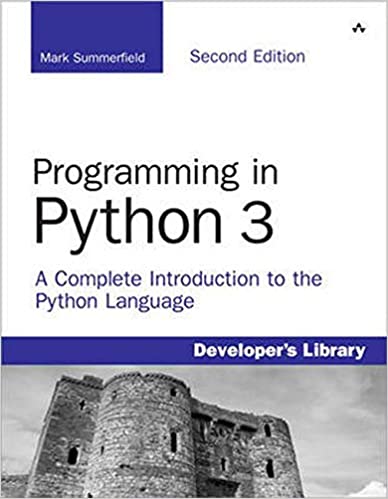
Programming in Python 3 by Mark Summerfield

Python is an extremely powerful but easy to learn programming language. If you have prior knowledge of any programming language you can learn Python in just few hours and you can be a proficient developers in just some days.

However this simplicity can be dangerous too if you stay at the basics and don´t go further into this wonderful language. It's easy to keep using it just as an script language and think that that is all with Python. But actually Python is complete development language that you can use with almost anything you would need with an ease and expressiveness not easy to find in any other language.

This books focus in Python 3, the new generation of this language that now is its standard. Such an an evolution lap was not able to offer full backwards compatibility with former Python 2.7 branch. But actually this books gives a good guidance to promote your Python code to 3 branch. Book's content is extremely complete covering from basics (flow control, strings, files) to advanced topics (decorator, context manager, functors, abstract classes and metaclasses and a huge etc). Those topics will prove to be very useful to help you to translate easily mental concepts to code. All those concepts are explained with clean code, well commented and easy to understand.

As a summary, this is a good book both for newbies who want to start from the begining and for those with good expertise that want to get full advantage from Python. Besides, once finished this book is a good language reference to keep at hand on your bookshelf.

08 April 2020

Practical Lock Picking by Deviant Ollam

Security engineering ranges many fields. One of those fields is physical security. Historically one of the main pillars of physical security are locks, like you can find at doors, safes, drawers or treasure chests. Knowing how they work and how they can be subverted to make them open should be part of any security engineer expertise. Too often, the access card to the super-critical-Data-Processing-Center is kept inside a mere office drawer with a simple waffer lock.

Practical Lock Picking is written by a professional lock-picker in a clean and simple manner. Currently it focuses in to lock kinds: pine and waffer. Actually that covers 90% of doors and drawers nowadays. Author starts by describing both locks manufacturing process to enumerate their usual manufacturing defects, defects that can be used make them open. Afterwards, book describes usual methods and tools to make those locks open. Everything is plenty of diagrams to explain visually every step.

Although, author is a professional he is aware that his potentials readers are newcomers to this topic, so explanations are very detailed and he makes a real effort to put himself in a newbie feet. So he offers advice about how to start a collection of training locks and lock-picking locks, at a low initial cost and following a progressive difficulty when trying new locks.

Overall, this book is good and I find it a must have for any security engineer bookshelf.

06 April 2020

Security Engineering by Ross Anderson

Security Engineering by Ross Anderson is likely the best security book I've read so far.

Whereas other books explain from a technical point of view exclusively, Anderson focus on concepts establishing the mental framework to guide a security engineer along his professional career. So he does not refer to any specific firewall brand, programming language or operating system, but to design successes and failures along Information Technologies and Communications history. This is so enriching because dominant vendors marketing try to convince you that you only need to invest vast amounts of money to buy latest tech to get your information assets secure. However for Anderson technology is just a tool to perform a proper assess and design, from a mental framework based on comprehensive concepts independent from the latest tech state of art.

Along this book, these concepts are assessed, applying them to every information security field comparing them with historical events. So, many topics are covered. Topics so interesting and different like psychology, ergonomics, cryptography, access control policies to information assets, economics impact on security, integrity controls, security in shared data environments, intellectual property, terrorism and a quite long etc... 

The author's long expertise gives many examples to book from banking, defense industry and intelligence sector (of course, those sectors have been the great developers of current information security state of art). In those examples you get detailed descriptions ranging from IFF systems (Identify-Friend-or-Foe) to command and control military organizations; from the evolution of nuclear missiles protocols to improvements of electronics to spy electromagnetic emissions.

Besides, this books is going to stay relevant on your shelf for long as happens with general topics covered in it. This book is not one of those that end in your basket after some years.

All that makes Security Engineering a critical book for any security engineer and a good investment worth every penny you use to buy it.

28 March 2016

The Hacker's Playbook

When reading technical books I mainly find three kind of books: those that don't teach anything new, those that are gold mine of knowledge and those that only scratchs the surfaces of topics but give you interesting links to investigate further on. I think that "The Hacker's Playbook: Practical Guide to Penetration Testing" by Peter Kim is placed in the third category: just reading it you won't be a master pentester but if you really investigate the links and resources the author points you'll definitely get the mastery.

The book deals with many topics but not profoundly: scanning (network and web), exploiting, privilege elevation, networks attacks (wired and wireless), social engineering, AV-evasion, password cracking, etc. I think that as an introductory text is right and it's well focused because it explains things using tools "open source" or freely available, but where this books excels is pointing at public resources to go deeper in your learning. There are a wealth of links along the book all all of them points to really interesting web resources with tools, courses, tutorials and, and this is very important, places to train your skills without end with SWAP knocking your door.

Text is well written and explanations are concise and easy to understand. Content is cleverly structured and covers almost every field in penetration testing.

Taking in count it's not an expensive book I've found worth buying and reading it and I recommend it for introductory levels or for mediums levels who want a quick state-of-the-art review.


12 January 2016

Functional Python Programming

I always wanted to know what was about that thing called functional programming, but I didn't want top learn a new language to understand functional programming, not now at least. So when a found a book dealing the topic (Functional Python Programming by Steven Lott) from a Python focus I read it.

After reading it I feel that I've been following a lot of functional programming principles without even realizing it: short functions, don't alter outer states from inside a function, use iterators (lazy-evaluation) wherever possible, etc. That doesn't mean I didn't learn anything, for instance I really enjoyed the examples about features in itertools library which I hadn't used so far.

It includes some advices I'm not going to follow, like the one about chaining functions. The book really like function chaining (you know, inserting a function call as a parameter for another function) but doing that you end with really long line codes that I feel entirely un-pythonic. Besides, they really like recursion but I fell unconfortable with that concept and to be honest I didn't understand the books example about tail optimizations.

Nevertheless the book is extensive, systematic and includes a lot of example so I think it's worth reading it to get some concepts to improve your overall coding skills.

12 July 2015

Effective Python

When you learn a language there is a point where beginners books don't give you anything useful any longer, where you can develop almost anything you want with what you know so far but that level of knowledge is not enough, you want to master the language and improve your skills a little more everyday.

"Effective Python" is the kind of book to read when you get that point. It's not a book for beginners but a book for developers who want to be really pythonic.

Written by a Google engineer, it covers several developments areas like functions, classes, metaclasses, concurrency, collaboration, production, etc, through many recipes and examples. You can read this book sequentially or not. It has many similarities with books like "Python Cookbook". Some topics will be known for you, some others will be new and interesting. In the end you'll use this book as a reference when you come across situations like the depicted ones in the book.

I'm my humble opinion the money to get this book is well invested. I got examples and tricks about topics and possibilities really useful for my developments and many months after reading it I keep coming back to this book for references.